Showing posts with label philippine banknotes. Show all posts

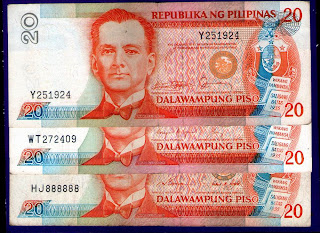
20 Piso Banknote - 25 years, 6 presidents

Even though our 20 peso bill design was practically unchanged for 25 years since 1985, it has borne the signature of six Philippine Presidents and five central bank governors. Indeed, banknotes are witnesses to, and themselves artifacts of, our Nation's history.

We thank our blog reader and fellow banknote collector, reyn, for contributing the images below that display the signatures of all six presidents since Ferdinand Marcos.


New 1000 Peso Bill - New Generation Banknotes

One Thousand Piso Banknote
Obverse: War Heroes - Josefa Llanes Escoda, Vicente P. Lim, and Jose Abad Santos; Centennial of Philippine Independence (1998); Medal of Honor; Seal of the Republic of the Philippines; and the New BSP Seal
Reverse: Tubbataha Reefs Natural Park (UNESCO World Heritage Site); South Sea Pearl (Pinctada maxima), Tinalak or Ikat-dyed abaca woven in Mindanao in Southern Philippines
Security Features: (1) embossed prints, (2) serial number, (3) security fibers, (4) watermark, (5) see-through mark, (6) concealed value, (7) security thread, (8) optically variable device, (9) optically variable ink

War Heroes
Josefa Llanes Escoda (20 September 1898-January 1945) is a social worker, educator, advocate of women's right to vote; founder of the Girl Scouts of the Philippines and newspaper editor. She showed extraordinary courage by continuing to help prisoners of war during the Japanese Occupation. For this, she and her husband Antonio were killed before the end of the war.

Brigadier General Vicente P. Lim (24 February 1888 - 31 December 1944) was the first Filipino West Point graduate and rose to the rank of Chief of Staff of the Philippine Army. Initially wounded in action, he directed guerrilla activities from his hospital bed during the World War II. He was eventually captured and died in the hands of the Japanese. For his military service, he received the Legion of Merit and the Purple Heart.

Jose Abad Santos (19 February 1886 - 2 May 1942) was the Chief Justice of the Philippine Supreme Court. He completed his Bachelor of Laws degree in Northwestern University and Masters of Laws from Georgetown University as a scholar. He was executed for refusing to cooperate with the Japanese forces. Informed of his impending execution, he told his son ho had been captured with him: "It is a rare opportunity to die for one's country."

The 130,000 hectare Tubattaha Reef Marine Park in Sulu Sea is one of the Philippines' oldest ecosystems. It is home to a great diversity of marine life: whales, dolphins, sharks, and turtles are among the key species found here. The reef ecosystem supports over 350 species of coral and almost 500 species of fish. Declared as a UNESCO World Heritage Site, it plays a key role in the reproduction, dispersal, and colonization by marine organisms in the whole Sulu Sea system and in helping support fisheries outside its boundaries. It is a natural laboratory for studying ecological and biological processes, displaying process of coral reef formation, and supporting marine species dependent on reef ecosystems. The presence of tiger and hammerhead sharks, which are top predator species, indicates the ecological balance of the property.
South Sea Pearls - Sulu Sea is part of the South Seas, which are the natural habitat of oysters that produce the largest pearls grown in the world - the Pinctada maxima. The colors of these treasures from the sea range from white to silver and golden.
New 500 Peso Bill - New Generation Banknotes

Five Hundred Peso Banknote
New Generation Series

Obverse: Icons of Democracy - President Corazon C. Aquino, Senator Benigno Aquino Jr. ; EDSA People Power I February 1986; Benigno S. Aquino, Jr. Monument; Seal of the President; New BSP Seal
Reverse: Puerto Princesa Subterranean River National Park (UNESCO World Heritage Site); Blue-naped Parrot (Tanygnathus lucionensis), woven cloth from Southern Philippines
Security Features: (1) embossed prints, (2) serial number, (3) security fibers, (4) watermark, (5) see-through mark, (6) concealed value, (7) security thread, (8) optically variable device

Icons of Democracy
President Corazon C. Aquino (25 January 1933 - 1 August 2009), the 11th President of the Philippines, is the first woman head of state. She assumed office following the historic non-violent People Power Revolution that toppled a dictatorship. Her major accomplishments were the restoration of democracy and the crafting of a new Constitution that limited presidential powers, established a bicameral legislature, and gave strong emphasis to civil liberties and human rights. She was married to former Senator Benigno Aquino, Jr.
Senator Benigno Aquino Jr. (27 November 1932 - 21 August 1983), stood against President Ferdinand Marcos who had declared martial law. His seven-year imprisonment under the dictatorship and assassination upon his return from exile galvanized the Filipinos to unite and oppose the dictatorship. This culminated in the peaceful People Power Revolution. The bronze memorial is in his honor in Makati City is a popular venue for holding mass movements.

The funeral processions of both President Corazon Aquino and Senator Benigno Aquino were an outpouring of national grief. Millions of people stayed on the roads for hours to pay their respects and to express their deep gratitude to the couple who dedicated their lives for the country and the Filipinos. On 30 June 2010, their only son Benigno S. Aquino III became the country's 15th President.

The eight-kilometer Puerto Princesa Subterranean River National Park in Palawan winds through a cave that has major formations of staltactites and stalagmites that fascinate and mesmerize. Declared as a UNESCO World Heritage Site, the pleace has a full mountain-to-the-sea ecosystem that is also home to rare animals such as the Philippine cockatoo and the Palawan mouse deer.

The rare Blue-naped Parrot thrives in the lush forests of Palawan and Mindoro. Parrots are known to be friendly, gentle, and intelligent.

New 200 Peso Bill - New Generation Banknotes

Two Hundred Piso Banknote
New Generation Series

Obverse: President Diosdado P. Macapagal; EDSA People Power II (January 2001); Independence House; Barasoain Church; Seal of the Republic of the Philippines; and the New BSP Seal
Reverse: Bohol Chocolate Hills; Tarsier (Tarsius syrichta); handcrafted design from the Visayas in Central Philippines
Security Features: (1) embossed prints, (2) serial number, (3) security fibers, (4) watermark, (5) see-through mark, (6) concealed value, (7) security thread

President Diosdado P. Macapagal (28 September 1910 - 21 April 1997) is known for his land reform and socio-economic agenda that started the process of economic liberalization and the shift to a market economy in the Philippines. He moved the celebration of Philippine independence from 4 July 1946 to 12 June 1898 when General Emilio Aguinaldo declared independence from Spanish colonial rule and, in the process, made the Philippines Asia's first republic. Barasoain Church in Malolos Bulacan was the venue for the inauguration of the First Philippine Republic. Aguinaldo's home in Cavite is now called the Independence House.

President Diosdado Macapagal is the father of President Gloria Macapagal-Arroyo who assumed office as a result of the EDSA People Power II in January 2001.

The famous Chocolate Hills of Bohol are verdant green mounds during the rainy season that turn chocolate brown at the end of the dry season. Numbering about 1,268 hills, they rise to 30 to 50 meters.

The Philippine tarsier is described as one of the world's smallest primates; it can fit comfortably in one's hands. It can be found in Bohol and in Samar, Leyte, and Mindanao.

New 100 Peso Bill - New Generation Banknotes

One Hundred Piso Banknote
New Generation Series

Obverse: President Manuel A. Roxas; Central Bank of the Philippines (1949); Inauguration of the Third Republic (4 July 1946); Seal of the Republic of the Philippines; and the New BSP Seal
Reverse: Mayon Volcano; Whale Shark (Rhincodon typus); Indigenous textile from the Bicol Region
Security Features: (1) embossed prints, (2) serial number, (3) security fibers, (4) watermark, (5) see-through mark, (6) concealed value, (7) security thread

President Manuel A. Roxas (1 January 1892 - 15 April 1948) took his oath of office on 4 July 1946 as the first president of the Third Philippine Republic, when the United States recognized the independence of the Republic of the Philippines. Having inherited a nation in the ruins of World War II, he set in motion the crafting of the first Master Economic Plan, the first known in developing Asia, which started the country on the road to reconstruction and development. He thus earned the title "Nation Builder." A Philippine Bar topnotcher, he had a lifelong career as public servant. He was 27 when he became Governor of the Province of Capiz, the country's youngest, and was Speaker of the House for 12 consecutive years. One of his priorities was the drafting of a charter for a central bank, which he deemed as a step towards sovereignty. However, he did not complete his term due to a fatal heart attack. Shortly after his death, his successor President Elpidio Quirino signed Republic Act 265 or the Central Bank Act in June 1948. On 3 January 1949, the Central Bank of the Philippines opened for business.

The Bicol Region is famous for majestic Mayon Volcano, the country's most active which has a near perfect cone. It is in Legazpi City, Albay.

The "butanding" or whale shark, the world's largest living fish, is the main attraction in Donsol, Sorsogon. These gentle giants regularly visit the waters of Sorsogon to mate and to feed on plankton abundant in Donsol River.

New 50 Peso Bill - New Generation Banknotes

Fifty Piso Banknote
New Generation Series

Obverse:
President Sergio Osmeña; First National Assembly 1907; Leyte Landing; Seal of the Republic of the Philippines; and the New BSP Seal
Reverse: Taal Lake; Maliputo (Caranx ignobilis); embroidery design handcrafted in Batangas province
Security Features: (1) embossed prints, (2) serial number, (3) security fibers, (4) watermark, (5) see-through mark, (6) concealed value, (7) security thread

President Sergio Osmeña (9 September 1878 - 19 October 1961) is the president who led the Philippines during the critical stage nearing the end of World War II and in the transition as an independent nation. He was vice president when President Manuel Quezon passed away and was with the liberation forces led by US General Douglas McArthur in 1944, an event immortalized at a landmark monument known as the "Leyte Landing" at Palo beach in central Philippines. It was during his term when the Philippines joined the United Nations, the International Monetary Fund, and the International Bank for Reconstruction and Development (World Bank)

Taal Lake in Batangas is the deepest freshwater lake in the Philippines. It is also host to active Taal Volcano, the world's smallest volcano.

The Giant Trevally, locally known as Maliputo, a delicious milky fish, thrives only in the waters of the lake. Taal Lake is also the only home of tawilis, the world's only freshwater sardine.

New 20 Peso Bill - New Generation Banknotes

Twenty Piso Banknote
New Generation Series

Obverse: President Manuel L. Quezon; Filipino as National Language (1935); Malacañan Palace; Seal of the Republic of the Philippines; New BSP Seal
Reverse: Banaue Rice Terraces (UNESCO World Heritage Site); Palm Civet (Paradoxurus hermaphroditus philippinensis), Weave design from the Cordilleras
Security Features: (1) embossed prints, (2) serial number, (3) security fibers, (4) watermark, (5) see-through mark, (6) concealed value, (7) security thread

President Manuel L. Quezon (19 August 1978 - 1 August 1940)
Popularly known as the "Father of the National Language," Manuel L. Quezon is the second president of the Philippines and the first to be elected through a national election. He worked tirelessly to gain recognition for the Philippines as an independent nation. During his term, a national language for the Philippines was adopted and Filipino women were given the right to vote. Quezon is the first Filipino president to hold office in Malacañan Palace by the Pasig River in Manila.

The Banaue Rice Terraces in Northern Philippines were carved out of the mountains of the Cotrdilleras around 2,000 years ago by Filipino ancestors using simpe tools. Breathtaking for its high altitude, steep slopes and area covered, the Banaue Rice Terraces showcases a mastery of engineering that is appreciated to the present. It has been declared a World Heritage Site by the United Nations.

The palm civets in the Cordilleras are famous for producing one of the best and expensive coffee varieties in the world - Coffee Alamid. The coffee beans that they eat, partially digest, and released as droppings are prized for their flavor and aroma.

100 Peso Bill - English Series

(photo courtesy of Sonny Ronquillo)
One Hundred Peso Banknote

1949 English Series

Obverse: Tandang Sora (Melchora Aquino) and the Central Bank Seal
Reverse: various flags of the Katipunan

Signatures: Philippine President Elpidio Quirino and Central Bank Governor Miguel Cuaderno, Sr.

Text
Obverse:
Central Bank of the Philippines. This note is a liability of the Central Bank of the Philippines and is fully guaranteed by the Government of the Republic of the Philippines. One Hundred Pesos. This note is legal tender in the Philippines for all debts, public and private. Thomas De La Rue & Co. Ltd.
.

Manny Pacquiao on 5 Peso Bill

The Pacquiao vs Marquez Unfinished Business boxing match is at 8AM tomorrow, Philippine time. With that, it is time to add to our online collection this interesting 5-peso bill spoof featuring Manny Pacquiao at the obverse and one of his boxing matches at the back. It is a fine revival of the five peso banknote already out of print.

This spoof of the five peso bill has circulated in the internet last 2006 after Manny Pacquiao defeated Erik Morales and Oscar Larios in much anticipated boxing matches. Efforts were made to trace the creator of this banknote spoof but to no avail. Whoever you are, nice work!

Security Fibers - Security Feature

There are two kinds of security fibers. The first one is the visible security fibers. These are easily seen in current Philippine banknotes as the blue and red fibers that are randomly spread throughout the front and back of the paper. The other kind is the invisible security fiber. These glow a fluorescent yellow under ultraviolet light.

Security fibers are another form of security feature in Philippine money that guard against counterfeiting. Genuine security fibers in Philippine banknotes can be easily plucked out (yes, try it!) with the aid of a needle. Counterfeit money usually only prints the fibers on paper, thus , they cannot be plucked out.

Current Legal Tender Philippine Banknotes

Current Philippine legal tender banknotes are referred to as the New Design Series. This series was first issued in 1985. The 500 and 1,000 piso notes were released later in 1987 and 1991 respectively.

For details, click on the images below

1000 Pesos


500 Pesos


200 Pesos


100 Pesos


50 Pesos


20 Pesos


10 Pesos, 2nd version
Out of print but still legal tender


10 Pesos, original version
Out of print but still legal tender


5 Pesos
Out of print but still legal tender

Also in legal tender are various commemorative banknotes such as the 2000 and 100,000 peso bills.

1000 Peso Bill - New Design Series

One Thousand Piso Banknote
New Design Series

Obverse: Jose Abad Santos, Josefa Llanes Escoda, Vicente Lim, Eternal flame, Laurel Leaves Cenrtral Bank Seal
Reverse: Hagdan-hagdang Palayan ng Banawe, Manunggul jar cover and Langgal hut

Predominant color: Blue
Security thread: 0.75 mm embedded magnetic and metallic; for newer notes, 1.4 mm windowed colorshift (magenta-green) with cleartext “1000”

Length: 160mm
Width: 66mm
Thickness: 100-118 microns
Material: 20% abaca, 80% cotton

Security Features: security thread, red & blue visible fibers, fluorescent printing, iridescent band, windowed security thread, optically variable ink (OVI), and micro-printing

Text: "Republika ng Pilipinas", "Sanlibong Piso", "Ang salaping ito ay bayarin ng Bangko Sentral at pananagutan ng Republika ng Pilipinas"

Jose Abad Santos (Chief Justice), Josefa Llanes Escoda (civic worker and one of the founders of the Girl Scouts of the Philippines), and Vicente Lim (a general in the Philippine Army, first Filipino graduate of West Point) are considered heroes of the resistance against the Japanese Occupation of the Philippines.

The Manunggul Jar is a National Treasure of the Philippines. The jar was found in Chamber A of the Manunggul caves in Palawan. The jar is dated from about 2800 years before the present day. The faces of the figures and on the prow of the boat have eyes and mouth rendered in the same style as other artifacts of Southeast Asia of that period. Note the depiction of sea-waves on the lid.

Banaue Rice Terraces (Tagalog: Hagdan-hagdang Palayan ng Banaue) are 2000-year old terraces that were carved into the mountains of Ifugao in the Philippines by ancestors of the Batad indigenous people. The Rice Terraces are commonly referred to as the "Eighth Wonder of the World". They are found in the provinces of Apayao, Benguet, Mountain Province and Ifugao, and are a UNESCO World Heritage Site.

The Langgal hut is a Muslim place of worship particularly in Sulu, headed by an Imam who is assisted by the Habib and ilal.

500 Peso Bill - New Design Series

Five Hundred Piso Banknote
New Design Series

Obverse: Benigno S. "Ninoy" Aquino, Jr., Philippine flag, Central Bank seal, dove of peace, Ninoy's typewriter with his initials ("B.S.A.J."), "Faith in our people and faith in God", "The Filipino is worth dying for"
Reverse: scenes from Ninoy Aquino's life and some allegorical groups (see note below)

Predominant color: yellow
Security thread: 0.75 mm embedded magnetic and metallic; for newer notes, 1.4 mm windowed colorshift (magenta-green) with cleartext “500”

Length: 160mm
Width: 66mm
Thickness: 100-118 microns
Material: 20% abaca, 80% cotton

Security Features: security thread, red & blue visible fibers, fluorescent printing, iridescent band, windowed security thread, concealed numerical value, and micro-printing

Text: "Republika ng Pilipinas", "Limandaang Piso", "Ang salaping ito ay bayarin ng Bangko Sentral at pananagutan ng Republika ng Pilipinas"

The reverse side features a collage of various images in relation to Aquino. He was (out of some of the pictures) a journalist for the Manila Times, a senator (the pioneer of the Study Now, Pay Later education program), the mayor in his hometown of Concepcion, the governor of Tarlac, and was the main driving force behind the People Power Revolution of 1986, some three years after his death in 1983.

It is also interesting to note that unlike the names of the figures on the bills, "Benigno S. Aquino, Jr." is written in gold-coloured, cursive writing with a green laurel wreath as opposed to the name being simply written as with the other banknotes.

Before this note was printed, 500-piso banknote was to have Ferdinand Marcos and its back was the Batasang Pambansa Complex until People Power Revolution when it was replaced by the current 500-piso banknote. Remnants of this version of the banknote are only for media purposes.

Related post: Cory to Join Ninoy on P500 bill?

200 Peso Bill - New Design Series

Two Hundred Piso Commemorative Banknote
New Design Series

Obverse: Diosdado P. Macapagal, Aguinaldo Shrine in Kawit, Kavite
Reverse:
scene from EDSA II, with Gloria Macapagal-Arroyo being sworn in as president by Chief Justice Hilario Davide Jr. in January 2001

Predominant color: Green
Security thread: 0.75 mm embedded magnetic and metallic/1.4 mm windowed colorshift (magenta-green) with cleartext “200”

Length: 160mm
Width: 66mm
Thickness: 100-118 microns
Material: 20% abaca, 80% cotton

Security Features: security thread, red & blue visible fibers, fluorescent printing, iridescent band, windowed security thread, micro-printing, 0.75 mm embedded magnetic and metallic/1.4 mm windowed colorshift (magenta-green) with cleartext “200”, and perfect see-through register

Text:
Republika ng Pilipinas, Ang Salaping ito ay bayarin ng Bangko Sentral at pananagutan ng Republika ng Pilipinas. Dalawandaang Libong Piso

This banknote is signed by Gloria Macapagal Arroyo and Rafael Buenaventura. The little girl holding a Bible in between Arroyo and Davide at the reverse of the note is Cecilia Paz Razon Abad, daughter of former Philippine Education Secretary Florencio Abad and Batanes Representative Henedina Razon-Abad.

The bill was subject of criticisms by the opposition. They said that the legal tender should only feature deceased national heroes and not an incumbent President. It wasn't the first time that a legal tender featured a sitting President. Legal tender coinage was minted to commemorate the inauguration of Manuel L. Quezon as President of the Philippines in 1935. Emergency currency during World War II had many instances where provincial emergency currency boards placed the image of then President Manuel L. Quezon. In 1975, Bangko Sentral ng Pilipinas released a 5-Piso coin featuring the face of then President Ferdinand Marcos. Former Presidents Fidel Ramos and Joseph Estrada was also pictured in a limited commemorative 2000-Piso bill that honors the 100-year celebration of Philippine Independence. Also a limited commemorative gold 1000-Piso bill with the picture of former President Joseph Estrada was also issued to honor the 100-year celebration of Philippine Independence.

This note is also a commemorative banknote, released in 2002 to commemorate Philippine independence.

100 Peso Bill - New Design Series

One Hundered Piso Banknote
New Design Series

Obverse: Manuel A. Roxas, raising of the Philippine flag and lowering of the American flag during the declaration of Independence in July 4, 1946, Central Bank Seal
Reverse: Central Bank Complex along Roxas Boulevard with an inset image of the former Central Bank Building

Predominant color: Violet
Security thread: 0.75 mm embedded magnetic and metallic; for newer banknotes, 1.4 mm windowed colorshift (magenta-green) with cleartext “100”

Length: 160mm
Width: 66mm
Thickness: 100-118 microns
Material: 20% abaca, 80% cotton

Security Features: security thread, red & blue visible fibers, fluorescent printing, iridescent band, windowed security thread, and micro-printing

Text: "Republika ng Pilipinas", "Sandaang Piso", "Ang salaping ito ay bayarin ng Bangko Sentral at pananagutan ng Republika ng Pilipinas"

The 100-piso banknote became subject of controversy after banknotes printed in France in time for the Christmas season were printed with the President's name misspelled, the first in Philippine history. The banknotes, of which a small amount are in circulation and are still legal tender, spelled the President's name as "Gloria Macapagal-Arrovo" than the correct Gloria Macapagal-Arroyo. More...

50 Peso Bill - New Design Series

Fifty Piso Banknote
New Design Series

Obverse: Sergio Osmeña, Fuente Osmeña (Osmeña Fountain), gavel, Central Bank Seal
Reverse: National Museum "Pambansang Museo" (formerly Legislative Building)

Predominant color: Red
Security thread: 0.75 mm embedded and metallic

Length: 160mm
Width: 66mm
Thickness: 100-118 microns
Material: 10% linen, 90% cotton

Security Features:
security thread, red & blue visible fibers, fluorescent printing, iridiscent band, windowed security thread, and microprinting

Text: "Republika ng Pilipinas", "Limampung Piso", "Ang salaping ito ay bayarin ng Bangko Sentral at pananagutan ng Republika ng Pilipinas"

Sergio Osmeña was the second president of the Commonwealth of the Philippines. He served as president from 1944, after Quezon's death, to 1946, when the United States granted the Philippines' independence.

The National Museum featured on the reverse side of the banknote, used to be the Legislative Building, where the House of Representatives that Osmena presided over as Speaker from 1907-1922 was located. The building was then renamed Executive House during the Martial Law period and was labeled as such in the fifty-piso banknote until recently.

20 Peso Bill - New Design Series

Twenty Piso Banknote
New Design Series

Obverse: Manuel Quezon, Coat-of-arms of the Commonwealth, Wikang Pambansa, Saligang Batas 1935, Central Bank Seal
Reverse: Malacañan Palace beside the Pasig River "Palasyo ng Malakanyang"

Predominant color:
Orange
Security thread: 0.75 mm embedded broken gold colored plastic

Length:
160mm
Width: 66mm
Thickness: 100-118 microns
Material: 10% linen, 90% cotton

Security Features: security thread, red & blue visible fibers, fluorescent printing

Text:
"Republika ng Pilipinas", "Dalawampung Piso", "Ang salaping ito ay bayarin ng Bangko Sentral at pananagutan ng Republika ng Pilipinas"

Manuel L. Quezon was the first president of the Commonwealth of the Philippines. At the right side of the banknote are the coat-of-arms of the Commonwealth, and two of Quezon's notable accomplishments. The first is Wikang Pambansa, which is Tagalog for "national language". In 1937, the National Language Institute was founded to establish a single national language for the Philippines. This eventually became the Filipino language, which is largely based on Tagalog. The second was the Saligang Batas 1935 or the 1935 Constitution of the Philippines. This was the first real constitution that was nationally effected and large parts of it survive in the current constitution.

The Malacañan Palace at the reverse is, more popularly known as Malacañang Palace, the residence of the President of the Philippines, along the banks of the Pasig River. Quezon was the first Philippine president to live in the Palace.

10 Peso Bill (2nd edition) - New Design Series

Ten Piso Banknote
New Design Series

Obverse: Apolinario Mabini (left) and Andres Bonifacio (right), KKK flag, Kartilya ng Katipunan, a letter written by Mabini
Reverse: Barasoain Church "Simbahan ng Barasoain" (left), initiation rites of the Katipunan "Mga bagong kasapi ng Katipunan na lumalagda sa mga kasulatan ng KKK sa pamamagitan ng kanilang dugo" (right)

Predominant color:
Brown
Security thread: 0.75 mm embedded broken gold colored plastic

Length:
160mm
Width: 66mm
Thickness: 100-118 microns
Material: 10% linen, 90% cotton

Security Features: security thread, red & blue visible fibers

Text: "Republika ng Pilipinas", "Sampung Piso", "Ang salaping ito ay bayarin ng Bangko Sentral at pananagutan ng Republika ng Pilipinas"

Andres Bonifacio was the founder of the Katipunan, a secret society established to fight the Spanish colonial government. Mabini was the Philippines first Prime Minister and Secretary of Foreign Affairs even though he was a cripple. Because of this, he was often called "The Sublime Paralytic".

The Barasoain Church in Malolos, Bulacan is the site of the first Philippine Congress where the Malolos Constitution was drafted. In the initiation rites of the Katipunan, members accepted into the society had to sign their name on the society's roster using their own blood.

The 10-piso banknote was issued months after the 5-piso banknote was issued. Before 1998, the 10-piso banknote only depicted Mabini and the Barasoain Church. In recent years, the new banknote has been replaced with a 10-piso coin also bearing the effigies of Bonifacio and Mabini.

The Bangko Sentral ng Pilipinas has stopped printing this banknote. However, existing banknotes remain legal tender.

10 Peso Bill (original version) - New Design Series


Ten Piso Banknote
New Design Series

Obverse: Apolinario Mabini and a letter written by Mabini
Reverse: Barasoain Church "Simbahan ng Barasoain"

Predominant color:
Brown
Security thread: 0.75 mm embedded broken gold colored plastic

Length:
160mm
Width: 66mm
Thickness: 100-118 microns
Material: 10% linen, 90% cotton

Security Features: security thread, red & blue visible fibers

Text: "Republika ng Pilipinas", "Sampung Piso", "Ang salaping ito ay bayarin ng Bangko Sentral at pananagutan ng Republika ng Pilipinas"

Mabini was the Philippines first Prime Minister and Secretary of Foreign Affairs even though he was a cripple. Because of this, he was often called "The Sublime Paralytic".

The Barasoain Church in Malolos, Bulacan is the site of the first Philippine Congress where the Malolos Constitution was drafted. In the initiation rites of the Katipunan, members accepted into the society had to sign their name on the society's roster using their own blood.

The 10-piso banknote was issued months after the 5-piso banknote was issued. Until 1998, this 10-piso banknote only depicted Mabini and the Barasoain Church. Years later, the bust of Andres Bonifacio was added to the left of Mabini's in a new design. Today, the Bangko Sentral ng Pilipinas no longer prints 10-piso banknotes but existing ones remain legal tender.