The Color of Money & The History of the Philippine Piso
The Color of Money
The color of money runs deeper than the obvious. With one look our money is green or red, violent, orange, yellow, or blue. As we look closer it changes into many different shades as painted by the countless stories it has become a part of. Our history, heroes, values, our daily life, the pursuit of happiness, and dreams fulfilled. Indeed the color of our money is the story - the pulse of our people. And as we evolve as a people, so does the color of our money.
The History of the Philippine Peso
The Filipinos first used paper currency in the mid 19th century while under Spanish rule.
With the establishment of the Central Bank of the Philippines in 1949, great Filipinos appeared for the first time on our banknotes, the English Series.
As our country progressed, our money continued its transformation. This time, it highlighted design elements that affirmed our independence.
In the 1960's, the english words on the notes were translated into the national language. Called the Pilipino series, the banknotes featured key events and places in our history.
In the 1970's, to echo the government's new society program, the phrase "Ang Bagong Lipunan" was stamped on the new bills. Our banknotes began to be printed in the newly built Security Plant Complex of the Central Bank.
The New Design Series was launched after the People Power REvolution in 1986. This included the 500-Piso banknote with the image of Senator Benigno Aquino, Jr. and the 1000-piso which featured three Filipino wartime heroes.
When the Bangko Sentral ng Pilipinas was created in 1993 as the country's central monetary authority, its new logo was incorporated in all the banknote denominations.
By the new millenium, the security features of the banknotes have been enhanced and the type of banknote paper upgraded with a shift from cotton linen to cotton with Philippine Abaca.


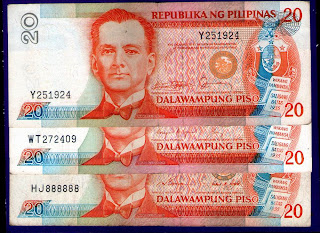
20 Piso Banknote - 25 years, 6 presidents
Even though our 20 peso bill design was practically unchanged for 25 years since 1985, it has borne the signature of six Philippine Presidents and five central bank governors. Indeed, banknotes are witnesses to, and themselves artifacts of, our Nation's history.
We thank our blog reader and fellow banknote collector, reyn, for contributing the images below that display the signatures of all six presidents since Ferdinand Marcos.

1 Peso Commemorative Coin - 150 years Jose Rizal

 One Piso Commemorative Coin
150 years Jose Rizal Birth Anniversary
Obverse: Jose Rizal, "150 years," "Republika ng Pilipinas," "1861-2011"
Reverse: logo of the Bankgo Sentral ng Pilipinas, "1 Piso," "2011"
Shape: round
Edge: reeded
Material: nickel-plated steel
Weight: 5.35 grams
Diameter: 24 mm
Mintage: 10 million
Designer: Emerson Rg Abraham.
This is the first legal tender coin to bear the new logo of the Bangko Sentral ng Pilipinas.
500 Peso Spoof - Ninoy Aquino Smiles!
Merry Christmas!
 As we commemorate the day of Jesus' birth, philmoney.blogspot.com would like to extend its wishes of joy to everyone.
Let us not spare Ninoy Aquino on the 500 peso banknote. His worried composure has no place in this time of rejoicing. Even the stars blink with joy!

(larger animated version)

Share the joy with your friends! Email this to them.
Fluorescent Marks - New Generation Currency
Fluorescent marks are the invisible phosphor dyes on banknotes that glow under UV or blacklight. Fluorescent prints are among the security features used in currency to deter counterfeiting (although counterfeiters are already able to imitate them). These are what cashiers look for when they hold down a banknote under a "counterfeit detector" which is actually a small black light.
These marks are not new, in fact we have previously written about fluorescent printing. However the New Generation Currency have interesting fluorescent marks that are worth another feature.
Bonus trivia! Did you know Philippine passports conceal intricate and beautiful fluorescent marks, many of which are also found on Philippine Banknotes? Among them are Malacanang Palace, Mayon Volcano, Chocolate Hills, Barasoain Church, Sampaguita, and Sarao Jeepney.

These marks are not new, in fact we have previously written about fluorescent printing. However the New Generation Currency have interesting fluorescent marks that are worth another feature.
[photos and details removed per request of BSP]
Bonus trivia! Did you know Philippine passports conceal intricate and beautiful fluorescent marks, many of which are also found on Philippine Banknotes? Among them are Malacanang Palace, Mayon Volcano, Chocolate Hills, Barasoain Church, Sampaguita, and Sarao Jeepney.


Subscribe to:
Posts (Atom)