Top Five Tips in Selling Old Philippine Coins

If you have some old Philippine coins lying around, you might be wondering how to sell them and make some extra cash. Here are some tips to help you get the best deal for your coins.

1. Know your coins.

Before you sell your coins, you should identify their type, date, mint mark, condition and rarity. You can use online guides, books or catalogs to help you with this. Some of the most popular and valuable Philippine coins are the US-Philippine coins (1898-1946), the Spanish-Philippine coins (up to 1898), the Flora and Fauna series (1983-1994) and the commemorative coins (1946-now).

2. Research the market.

You should check the current prices and trends of Philippine coins in the market. You can use online platforms like eBay, Carousell or Facebook groups to see how much other sellers are asking for similar coins. You can also visit coin shops, auctions or shows to get an idea of the demand and supply of Philippine coins.

3. Clean your coins carefully. 

You should never use harsh chemicals, abrasives or metal polish to clean your coins, as this can damage their surface and lower their value. You should only use a soft cloth, water and mild soap to gently wipe off any dirt or dust. You should also avoid touching your coins with your fingers, as this can leave fingerprints and oils that can tarnish them.

4. Grade your coins professionally.

If you have some rare or high-value coins, you might want to get them graded by a professional coin grading service like PCGS, NGC or ANACS. This will give you an official certification of your coin's authenticity and condition, which can increase its value and appeal to buyers. However, grading can be costly and time-consuming, so you should only do it if you think it's worth it.

5. Sell your coins wisely.

You should choose a selling method that suits your needs and preferences. You can sell your coins online through websites like eBay.ph, Carousell.ph  or Facebook groups, where you can reach a large number of potential buyers, but you also have to deal with shipping, fees and scams. You can also sell your coins offline through coin shops, auctions or shows, where you can get instant cash and negotiate in person, but you also have to travel, pay commissions and compete with other sellers.

BONUS TIP: The price of a coin is ultimately the price that both you and the buyer are willing to accept. In short, it depends on how quickly you want to sell the coin, and how badly buyers want it.

What are your own tips and experiences? Share them in the comments!

How do you disinfect money from viruses?

A recent study has shown that viruses such as that causing the new coronavirus disease (COVID-19) can survive on plastic for three days, two days on stainless steel, cardboard for 24 hours, and copper for four hours. There is no direct study on banknotes but this SARS-CoV-2 is apparently nasty when it comes to surviving on surfaces. Banks in China were aware of this early on such that they were sterilizing banknotes through ultraviolet (UV) and heat treatments and subjecting them to "quarantine" for seven to 14 days before releasing them.

Banknotes and cons are potentially underestimated vectors for viruses, not to mention fungi and bacteria, because they are thoughtlessly circulated quickly across communities and beyond lockdown borders. So how can we sanitize money that we bring into our household?

COINS are easy to sanitize. Soak them in water with soap or detergent, rub their surfaces a bit, and you are done. Soap and detergents are designed to burst the structure of viruses and wash them away in pieces.

BANKNOTES are more tricky but the surest way is still washing them in soap or detergent. Polymer notes may be rubbed down like coins but absorbent banknotes made of paper, cotton, and other fabric will need to be soaked for a few minutes. They are designed to survive this unusual treatment but drying them will take some time. Alternatively, ironing non-polymer banknotes in high heat subjects them to surfaces in excess of 200°C and should kill viruses with a few seconds of pressing. Do not iron polymer notes as high heat can damage them.

Finally, whenever possible, use contactless payments.

Fake News: New Generation Currency II 2020


False information has been circulation on social media regarding the issuance of a new set of Philippine peso bills, including a new PHP 5000 banknote. The graphic, showing poorly edited images of the supposed new bills, originated from a fake Bangko Sentral ng Pilipinas page on Facebook. Despite the poor quality of the graphics, they might have been passed as concept notes and they were shared widely on Facebook.

The Bangko Sentral ng Pilipinas has expressly denied the plan to issue new banknotes. Further, the public is advised to only follow the official BSP Facebook Page.

The Philippine New Generation Currency Coin Series (Video)


Bangko Sentral ng Pilipinas released a video showing the full set of the New Generation Currency Coin Series with the 10-, 5-, and 1-Piso coins along with the 25-, 5-, and 1-sentimo coins.


The 10-Piso coin features Apolinario Mabini on the obverse and the kapa-kapa (Medinilla magnifica) plant on the reverse. It is also the first Philippine coin with a milled-edge lettering spelling out "Bangko Sentral ng Pilipinas."


The 5-Piso coin, previously released in November 2017, features Andres Bonifacio on the obverse and the tayabak (Strongylodon macrobotrys) plant.

The 1-piso coin, features Jose Rizal and the waling-waling (Vanda sanderiana) plant.


The sentimo coins all feature a stylized Philippine flag with 3 stars and a sun. Their design only differs in the reverse. The 25-sentimo coin displays the katmon (Dillena philippinensis) flower, the 5-sentimo coin the kapal-kapal baging (Hoya pubicalyx), and the 1-sentimo coin the mangkono (Xanthostemon verdugonianus).


Notably, the 10-sentimo coin seems to have been phased out. Also, all coins are now silver in appearance which is sure to spell some trouble in differentiating similarly-sized coins.

Bonifacio displaces Aguinaldo in new 5 peso coin


To honor Gat Andres Bonifacio, the founder of the Katipunan on his 120th death anniversary this November 30, the Bangko Sentral ng Pilipinas (BSP) released in advance the new 5 Piso coin, the first of its new Generation Currency Coins.

Notably, Bonifacio displaces Emilio Aguinaldo, the first Philippine president who is rumored to have ordered Bonifacio's execution and who once occupied the coin. Bonifacio previously appeared on the 10 peso coin alonside Apolinario Mabini, Aguinaldo's key adviser.

Just last week, BSP released limited edition 10 peso coins featuring General Antonio Luna for his 150th birth anniversary. In 2015, a popular film Heneral Luna, was critical of Aguinaldo and his cabinet.

Bonifacio last appeared on the 5 peso domination, albeit on a banknote, in the Bagong Lipunan Series. After that, he occupied the 2-peso coin and then the 10 peso banknote alongside Mabini when the 2 peso denomination was demonetized. After the 10 peso banknote was demonetized, Bonifacio appeared with Mabini on the current 10 peso coin.

5 Peso Coin - New Generation Currency


Five Piso Coin
New Generation Currency 

Obverse: Gat. Andres Bonifacio, "Republika ng Pilipinas", 5 Piso, year mark
Reverse: Tayabak (a Philippine endemic plant that climbs tall forest trees), logo of the Bankgo Sentral ng Pilipinas

Shape: round
Edge: plain (design bordered by 12-scallop)
Material: nickel, brass
Composition: 70% copper, 5.5% nickel, 24.5% zinc

Weight: 7.4 grams
Diameter:
25 mm

Release date: November 30, 2017 (Bonifacio's 120th death anniversary and his 154th birthday)

New color of 100 peso bill

Top: Original colors of 100 peso banknote. Bottom: New banknote with light purple (mauve) color.
Some of you might have already noticed new one hundred peso banknotes with a different shade of purple. Don't worry, it's not fake.

Last month the Bangko Sentral ng Pilipinas started issuing new 100 beso bills with a pale purple (mauve) color. This was to address complaints that the 100 peso notes looked very similar to the 1000 peso bills.

500 Peso Ferdinand Marcos Banknote (Unissued)


1985 Unissued Marcos 500 Piso

Front: Ferdinand E. Marcos, Republika ng Pilipinas
Back: San Juanico Bridge, Angat Dam, Batasan Complex, Limandaang Piso

This banknote was supposed to be issued along with the rest of the New Design Series in 1985. However due to political circumstances, this design was never released into circulation. The banknote's designer Romi MananQuil narrates the story in his website:

The 500-peso Marcos bill was slated for production in late 1985. However, when a snap election was scheduled. The circulation of the newly printed bills was put on hold in deference to the law against electioneering as Marcos, whose image appeared on the new bank note was the incumbent running against Corazon Aquino. My 500-peso Marcos bill was never circulated and with the events that proceeded: the snap elections, the disputed victory of Marcos, the success of People’s Power in February 1986 and the instatement of Aquino as President, it perhaps seemed fitting that any vestiges of the overthrown government were thrown off. President Corazon Aquino soon ordered the redesign of the bill to honour her husband, Senator Benigno “Ninoy” Aquino whose 1983 slaying became the catalyst for change and the new democracy’s rallying cry for the overthrow of Marcos. Though I was once again tasked with the redesign of the bill, my family’s move to Canda prevented me from taking on the assignment. 

The Color of Money & The History of the Philippine Piso


The Color of Money

The color of money runs deeper than the obvious. With one look our money is green or red, violent, orange, yellow, or blue. As we look closer it changes into many different shades as painted by the countless stories it has become a part of. Our history, heroes, values, our daily life, the pursuit of happiness, and dreams fulfilled. Indeed the color of our money is the story - the pulse of our people. And as we evolve as a people, so does the color of our money.

The History of the Philippine Peso

The Filipinos first used paper currency in the mid 19th century while under Spanish rule.
With the establishment of the Central Bank of the Philippines in 1949, great Filipinos appeared for the first time on our banknotes, the English Series.

As our country progressed, our money continued its transformation. This time, it highlighted design elements that affirmed our independence.

In the 1960's, the english words on the notes were translated into the national language. Called the Pilipino series, the banknotes featured key events and places in our history.

In the 1970's, to echo the government's new society program, the phrase "Ang Bagong Lipunan" was stamped on the new bills. Our banknotes began to be printed in the newly built Security Plant Complex of the Central Bank.

The New Design Series was launched after the People Power REvolution in 1986. This included the 500-Piso banknote with the image of Senator Benigno Aquino, Jr. and the 1000-piso which featured three Filipino wartime heroes.

When the Bangko Sentral ng Pilipinas was created in 1993 as the country's central monetary authority, its new logo was incorporated in all the banknote denominations.

By the new millenium, the security features of the banknotes have been enhanced and the type of banknote paper upgraded with a shift from cotton linen to cotton with Philippine Abaca.

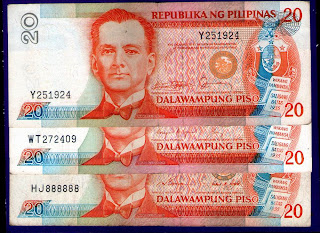
20 Piso Banknote - 25 years, 6 presidents

Even though our 20 peso bill design was practically unchanged for 25 years since 1985, it has borne the signature of six Philippine Presidents and five central bank governors. Indeed, banknotes are witnesses to, and themselves artifacts of, our Nation's history.

We thank our blog reader and fellow banknote collector, reyn, for contributing the images below that display the signatures of all six presidents since Ferdinand Marcos.


1 Peso Commemorative Coin - 150 years Jose Rizal

One Piso Commemorative Coin
150 years Jose Rizal Birth Anniversary

Obverse: Jose Rizal, "150 years," "Republika ng Pilipinas," "1861-2011"
Reverse: logo of the Bankgo Sentral ng Pilipinas, "1 Piso," "2011"

Shape: round
Edge: reeded
Material: nickel-plated steel

Weight: 5.35 grams
Diameter: 24 mm

Mintage: 10 million
Designer: Emerson Rg Abraham.

This is the first legal tender coin to bear the new logo of the Bangko Sentral ng Pilipinas.

500 Peso Spoof - Ninoy Aquino Smiles!

Merry Christmas!
As we commemorate the day of Jesus' birth, philmoney.blogspot.com would like to extend its wishes of joy to everyone.

Let us not spare Ninoy Aquino on the 500 peso banknote. His worried composure has no place in this time of rejoicing. Even the stars blink with joy!


(larger animated version)

Share the joy with your friends! Email this to them.

Fluorescent Marks - New Generation Currency

Fluorescent marks are the invisible phosphor dyes on banknotes that glow under UV or blacklight. Fluorescent prints are among the security features used in currency to deter counterfeiting (although counterfeiters are already able to imitate them). These are what cashiers look for when they hold down a banknote under a "counterfeit detector" which is actually a small black light.

These marks are not new, in fact we have previously written about fluorescent printing. However the New Generation Currency have interesting fluorescent marks that are worth another feature.


[photos and details removed per request of BSP]


Bonus trivia! Did you know Philippine passports conceal intricate and beautiful fluorescent marks, many of which are also found on Philippine Banknotes? Among them are Malacanang Palace, Mayon Volcano, Chocolate Hills, Barasoain Church, Sampaguita, and Sarao Jeepney.

Antibacterial Banknotes

It’s not hard to imagine just how dirty banknotes are. They are exchanged from one dirty hand to another, get dirty wet in markets, fall on dirty soil, and come in contact with other dirty money. We fold them, crease them, roll them, crumple them, even split them in half, thus wearing out their structure and providing more attachment surface for bacteria and fungi. No matter how dirty they become, we never throw them away nor even attempt to disinfect them with Lysol or alcohol. We just keep using them and they get dirtier and dirtier. It will not be surprising if someone can prove that banknotes are significant mediums for the spread of contagious diseases among people. Someone even said that banknotes should carry a government health warning.

It is good to know that the New Generation Currency of the Philippines is printed with Bioguard technology by Arjowiggins. Bioguard produces banknotes that are treated to prevent bacteria from multiplying. The anti-bacterial property has been tested to resist washing and will last throughout the lifetime of the banknote.

Here is a screenshot from their slideshow showing the difference between treated and untreated paper 24 hours after inoculation with E. coli bacteria.


How did they do this? They don’t say how, but most likely the banknote paper is treated with metallic ions which are known to have a wide range of antibacterial properties. Most notable among these ions is silver although copper, zinc, and other ions may also have been used. These ions inhibit the growth of bacteria and fungi.

So now, could we rub our hands on our banknotes instead of washing before eating? Maybe not, unless you’re willing to hold the banknote and let your food wait for 24 hours. But still this is a welcome feature to keep our banknotes cleaner and safer for the public.

Trivia: How many soldiers on 50 peso bill?

While the fifty peso banknote from the New Design Series (NDS) is still in wide circulation, let's challenge ourselves to a little trivia:

How many soldiers can you spot on the obverse (front) of the 50 peso bill (NDS)?
(clue: there are more than 0 of them)

2010 BSP Statistics on Coins and Banknotes

In their 2010 Annual Report, the Bangko Sentral ng Pilipinas gives us a glimpse on the volume of Philippine currency notes printed and coins minted during the past year.

Banknotes

870.05 million pieces printed
  • 213.85 million pieces with the signature of President Benigno Aquino III (launched 25 Nov 2010)
  • 10.0 million pieces of New Generation Banknotes (released 17 Dec 2010)

Currency retirement

  • 603.3 million pieces (worth P35.7 billion) notes retired through currency disintegrator

  • 443.0 million pieces (worth P204.5 billion) worn-out currency notes retired

2,956.8 million pieces (worth P746.7 billion) total banknotes in circulation as of 31 Dec 2010

Coins

582.02 million pieces minted

16,422.7 million pieces (worth P19.0 billion) total coins in circulation as of 31 Dec 2010

Looking at the figures of banknotes and coins in circulation, we can derive that if the population of the Philippines was around 94 million at the end of 2010 and all cash were distributed equally, each Filipino should have, P7,944 in banknotes and P202 in coins. Of course this does not include other forms of money such as bank deposits. Also, the average value of a banknote is P253 and coins are worth P1.16/piece on the average. Interesting!

How Philippine Banknotes are Printed

This is a very informative video from the Bangko Sentral ng Pilipinas (BSP) that shows how our banknotes are printed. It also explains why with BSPs ability to print money, they don't just print more money.


video source

Thorough planning and deliberation starts the process of making money available to the public. First, the Bangko Sentral's Department of Economic Research determines currency demand based on the expected price movement as well as the growth of population and the economy.

After this, the Cash Department places the order with the Security Plant Complex which in turn procures the materials needed to produce and print the banknotes. When the designs of banknotes are changed, final approval by the President of the Republic is required.

From the approved design, a prototype banknote is prepared. The banknote image is then etched on a master dye from which printing plates are produced. Meanwhile, ink experts mix the exact colors of the money.

With the ink and plates ready, printing begins on special security paper that is composed of 80% cotton and 20% Philippine abaca. This combination gives it a distinctive texture that sets it apart from ordinary paper.

The sheets of banknote paper go through offset printing where 15 to 20 colors of the design are printed at a time. Next, the paper goes through the inaglio printing process which gives the money its embossed look and feel. Raised ink from intaglio printing requires drying for several days.

After this, the banknote sheets are submitted for a series of inspections. The serial numbers are then printed on each banknote which are again subjected to thorough inspection. The sheets are then cut and packed into bundles of 1,000 pieces each.

These are now delivered by the Security Plant to the Currency Management Group from where banks exchange or withdraw their currency requirements. From the banks, the banknotes finally find their way to the economy and our wallets.

Indonesian Island in New Philippine Banknotes

I just got hold of my very own New Generation Currency Banknotes. As author of this blog, it is a shame it took me this long to get my hands on them. However, as I had my chance to actually scrutinize them in much detail, I spotted a weird island on the map on the reverse side, south of Mindanao. I found from Google Earth that the island is actually a depiction of the northern portion of Pulau Karakelong of Indonesia! Now how can BSP miss Batanes and include an Indonesian Island? (Sorry BSP for pointing this out.)

The shape of the island on the banknote design is unmistakably that of Pulau Karakelong even if whoever traced the shape of the island actually included only the northern portion. Compare the enhanced inset in the illustration above to the one on the banknote.

The island appears on both the 20 and 50 peso bills which I actually have but I'm sure it also appears on the rest of the denominations.

Looking at the illustration above, the 50 peso bill especially, the banknote design could have been better (and politically correct) had the island been excluded. Now I'm wondering if the Bangko Sentral's reason for excluding Batanes was actually an excuse.

Error in Scientific Names on New Generation Banknotes

Aside from tourist spots, the reverse side of the New Generation Banknotes feature also feature endemic and notable animals such as the tarsier (P200) and the whale shark (P1000). Along with their common English name, the animals are also labeled by their scientific name. Unfortunately, the scientific names are wrongly written!

Scientific names are written in binomial nomenclature where the first word is the genus name whose first letter should be capitalized. The second word is the species name which should be all lower-case letters. In the case of our new banknotes, both the genus and scientific names are written with their first letters capitalized. What's more, scientific names should be italicized and they are not.

Wrong:
Rhincodon Typus

Correct:
Rhincodon typus
The BSP should correct these mistakes or our science students would be seriously mis-educated about binomial nomenclature.

Scientific names were also ALL-CAPS in the Flora and Fauna and Improved Flora and Fauna Series of coins but this recent mistake in the still-to-be-released-banknotes are much more obvious.

Others have also previously complained about geographic errors in the new bills wherein the dot showing the location of Tubbattaha Reef in the 1000-piso bill is about 300 km off the mark.

New Generation Banknote Designs Released!

Finally! The Bangko Sentral ng Pilipinas has released the New Generation designs of Philippine banknotes including the new 500 peso bill with both Ninoy and Cory. Here they are!


So what's new with these banknotes?
  • More realistic portraits of former Philippine presidents and heroes
  • Tourist destinations and notable animals found in the country on the reverse
  • New BSP logo and Republic of the Philippines Seal
  • New euro-like design with large numbers for easy identification.
  • Security features are spruced most noticeably the serial numbers which some might find weird and the security thread which is wider. A foil-like optically variable device is found in the new 500 and 1,000 peso bills.
  • The paper used is "hygienically treated" or has anti-bacterial properties.
What's the same?
  • Color schemes were maintained except for the 20 peso bill which I think has a different tone of orange.
  • The size of all banknotes appear to have been maintained.
  • The same paper made of abaca-cotton. The BSP considered plastic/polymer before but they might have foreseen some problems with that especially with the way Filipinos crumple, fold, crease, and roll money.
Expect the new 20 and 50 peso bills next week in time for the Christmas! The rest will probably follow next year. Don't worry, the old designs will still be valid for the next three years.